
cHI HA PAURA DEL UOMO NERO?
cHI HA PAURA DEL UOMO NERO?
CHI HA PAURA DEL UOMO NERO?
A reparative motive in my work seeks pleasure rather than the avoidance of shame, but it also signals the capacity to assimilate the consequences of destruction and violence (S. Best, Reparative Aesthetics: Witnessing in contemporary art photography, 2016).
This approach allows for a healing process through art, embracing both the beauty and the scars of human experience.
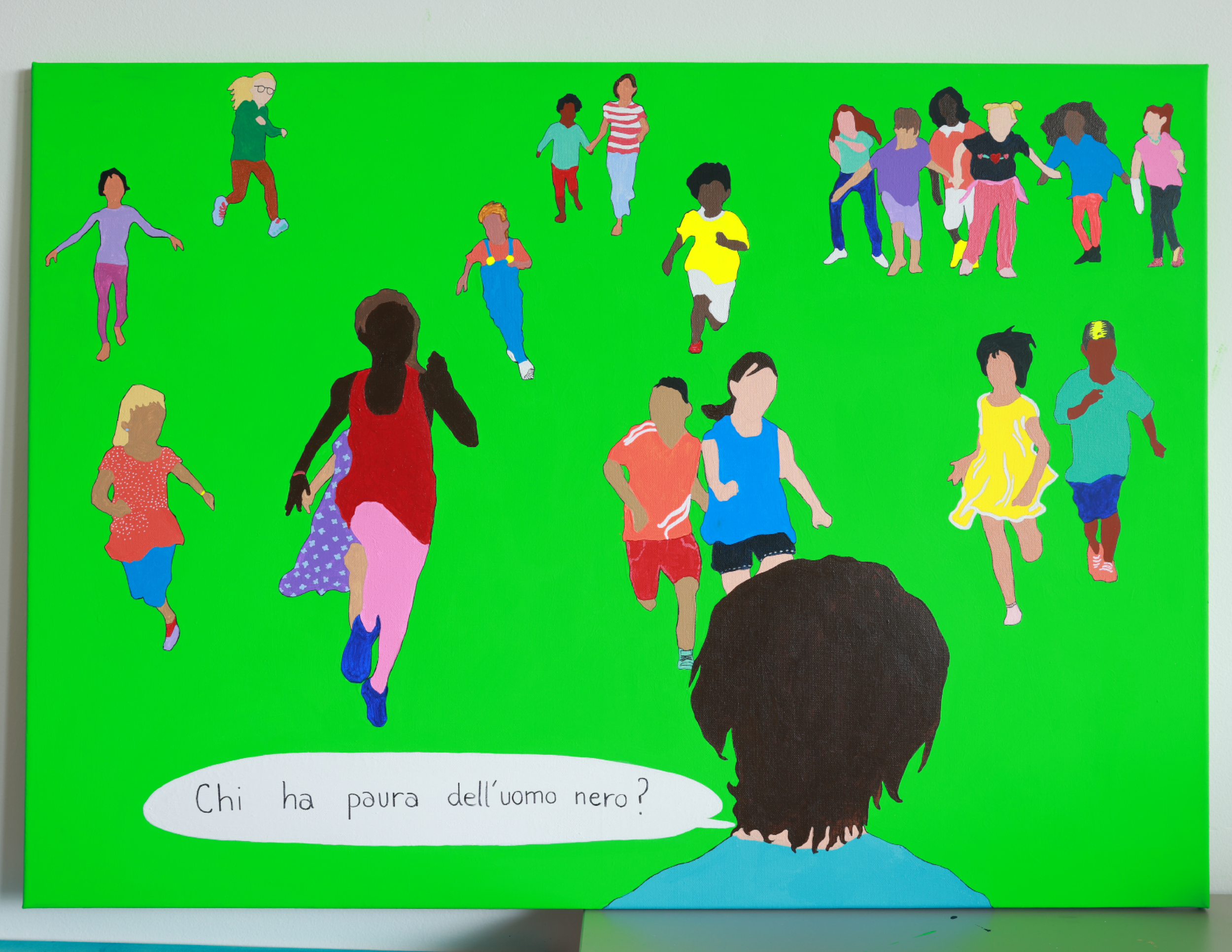
CHI HA PAURA DELL'UOMO NERO? is a painting connected to my ongoing series Legati al dito, which I started in 2024. The series takes its name from the Italian expression “legarsela al dito”, literally meaning to “tie something around your finger”, a way of saying that you remember something so strongly that you cannot simply let it go.
The starting point for this painting is a game I used to play as a child (during elementary school)in which one child would stand on one side of the playground and shout “Chi ha paura dell’uomo nero?” (“Who is afraid of the black man?”), before running towards the others and trying to catch as many children as possible. Whoever was caught would then become part of the uomo Nero and help chase the others, till eventually, everyone would have their turn at being the person who was supposed to be feared.
I loved this game. There was nothing particularly frightening about it to me as a child. It was running, screaming, catching your friends and trying not to get caught. We all became the uomo nero at some point. It was just a game.
And yet, looking back at it now, I cannot stop thinking about the sentence we were all taught to scream. I find it strange that a group of children could run around shouting “Who is afraid of the black man?” and that none of the adults around us, including our teacher, seemed to find the expression problematic, or even particularly worth questioning.
I am not interested in rewriting my childhood as something it was not. I genuinely loved playing this game. What interests me is the strange distance between how innocent something can feel when you are a child and how differently you can understand the same thing later. The game itself remains a happy childhood memory, while the words attached to it have acquired another weight, especially considering I had classmates with black skin.
Legati al dito
This contradiction is very much at the centre of Legati al dito. The paintings come from experiences that stayed with me, often moments in which I felt powerless in the face of injustice, but they are not simply paintings about suffering. I am interested in what happens when memories that carry discomfort, anger or shame are brought back into the present and looked at differently.
This is also why the paintings are full of fluorescent and metallic colours, they are almost aggressively bright. They do not allow the memories to sit quietly in the dark. The metallic surfaces also resist digital reproduction: the paintings change with the light and need to be physically encountered. In a way, they refuse to become a clean image of something that happened in the past.
Although I sometimes call these my “pain paintings”, I never want them to become only that. There is irony, playfulness and absurdity in them. The painful part of a memory can exist next to the ridiculous part, just as a childhood game can remain a lovely memory while also becoming something I later find unsettling.
This is where my work becomes personal, but not exclusively autobiographical. Many people around me carry similar contradictions in their own histories: non-white people, queer people, migrants, refugees, adopted children, “second-generation” migrants and people living precarious lives. The details of our stories can be completely different, but the feeling of looking back at something that once seemed normal and suddenly seeing it differently can be strangely familiar.
For me, remembering is therefore not about deciding whether something was good or bad. Sometimes it is both. Sometimes I loved something and I still question it. Sometimes the memory is funny, uncomfortable and painful at the same time. I think painting gives me a place where these contradictions do not have to be resolved.
There is a reparative motive in my work that seeks pleasure rather than the avoidance of shame, while also acknowledging the capacity to assimilate the consequences of destruction and violence (Susan Best, Reparative Aesthetics: Witnessing in Contemporary Art Photography, 2016). In that sense, the bright colours and playful character of the paintings are not an escape from the difficult parts of the memories. They are part of how I choose to live with them.
I still remember the game fondly.
I just don't know if I would teach it to children now.
CHI HA PAURA DEL UOMO NERO?
Fluorescent acrylic on canvas
65cm x 90cm
2026